
Corporate governance
For conducting various business activities based on the “SHIBAURA MACHINE Group Management Philosophy”, SHIBAURA MACHINE Group established the “SHIBAURA MACHINE Group Code of Conduct” to be observed by the directors and employees and developed systems such as internal control, group governance, and risk compliance to continuously improve the socially responsible corporate values. Through these actions, SHIBAURA MACHINE Group aim to secure highly transparent management practices.
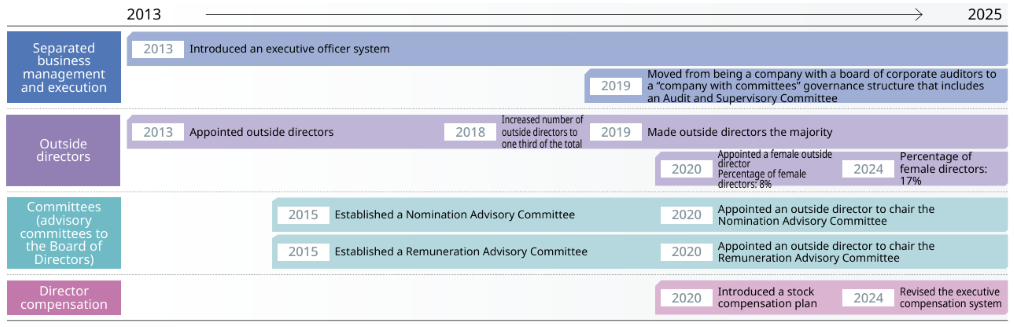
We have a highly transparent corporate governance system, including a proper internal control system established pursuant to our "Basic Internal Control Policy"; advisory committees on nomination and remuneration established to ensure greater transparency and fairness in nominating and remunerating directors and directors not on the audit and supervisory board; and an executive officer system designed to separate business management from business execution, specify managerial responsibility and ensure efficient and prompt business decision-making and execution. Furthermore, directors on the audit and supervisory board cooperate with the accounting auditor and the internal audit department to oversee business management.
Corporate Governance Reforms
We split off from the Toshiba Group in March 2017. After that point, we adopted a “company with committees” governance structure that includes an Audit and Supervisory Committee. We continue to further strengthen corporate governance, such as by increasing the number of outside directors.
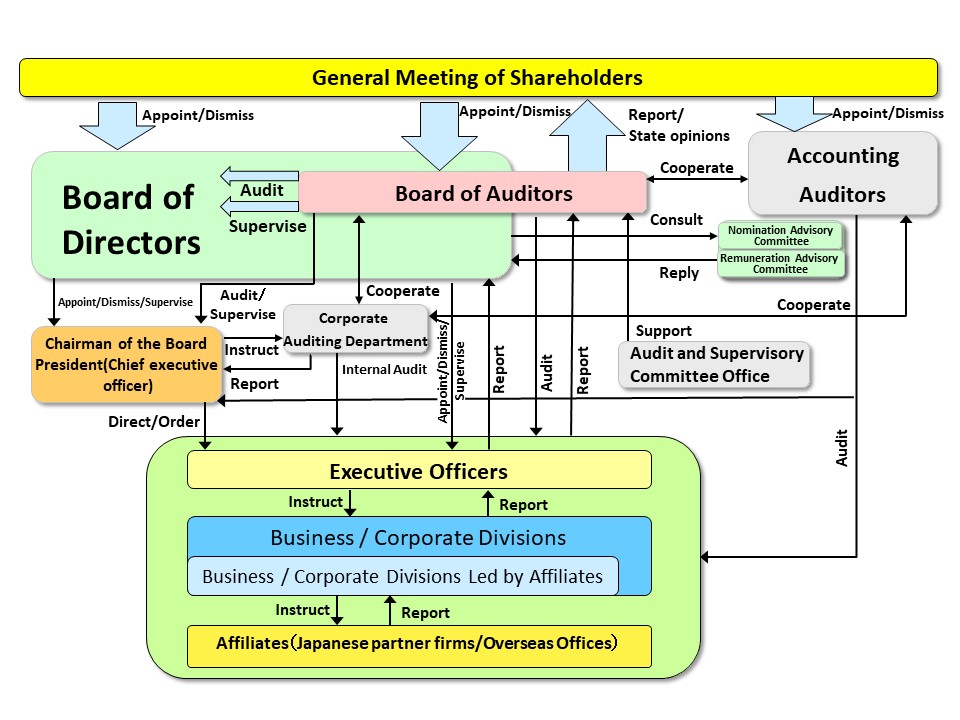
Corporate governance structure of SHIBAURA MACHINE Group
To ensure effective corporate governance, we have adopted a “company with committees” governance structure that includes an Audit and Supervisory Committee. Three Audit and Supervisory Committee members, of whom two are outside members and one is a full-time member, coordinate with the Internal Auditing Department, which conducts day-to-day audits of internal operations; attend the Management Strategy Meeting, the Management Meeting, and other important meetings; and state opinions as required. In addition, seven outside directors, who constitute a majority on the Board of Directors, utilize their expertise and business experience to ensure the rationality of the Company’s decision-making and enhance the supervision of directors’ execution of duties. Further, the executive officer system clearly separates management oversight from business execution, thereby accelerating and increasing the efficiency of decision-making.
- Board of Directors
The Company’s Board of Directors comprises nine directors (excluding directors who are Audit and Supervisory Committee members), of whom five are outside directors, and three directors who are Audit and Supervisory Committee members, of whom two are outside directors. As well as regular monthly meetings of the Board of Directors, extraordinary Board meetings are convened as required. In addition to deliberating, making decisions, and reporting on the stipulations of statutory laws and regulations and the Company’s Articles of Incorporation as well as important business matters, the Board of Directors develops the internal control system and ensures its effectiveness. Furthermore, the Company has designated the seven aforementioned outside directors as independent officers. Also, the Nomination Advisory and Remuneration Advisory committees have been established as advisory committees to the Board of Directors. The former deliberates on matters concerning the Company’s directors and other important personnel matters, while the latter deliberates on the remuneration of the Company’s directors, excluding directors who are Audit and Supervisory Committee members, with both committees reporting their findings to the Board of Directors. Further, both of these committees are chaired by outside officers. - Management Strategy and Management Meetings
The Management Strategy and Management meetings are both held monthly to deliberate, report on, and determine management policies and strategies as well as to deliberate, make decisions, and report on important matters related to business execution. - Audit and Supervisory Committee (Progress of Measures to Strengthen Audit Functions)
The Company’s Audit and Supervisory Committee has three members, of whom two are outside directors and one is a full-time member. By attending meetings of the Board of Directors and other important meetings, these Audit and Supervisory Committee members, who have voting rights, are able to audit and supervise the execution of duties by directors. In addition, they closely coordinate with the accounting auditor and the Internal Auditing Department to arrange audits of business management. - Internal Auditing Department
The Internal Auditing Department verifies the legality and appropriateness of business activities, reports audit results to the representative directors, and provides guidance if there are any matters requiring improvement. Further, the Internal Auditing Department comprises 15 members and is under the direct control of the representative directors. The Internal Auditing Department shares information with the Audit and Supervisory Committee and the accounting auditor in a timely manner, submits reports to the Audit and Supervisory Committee as required, and promotes mutual coordination with the committee. - Accounting Auditor and Lawyer
The Company has engaged Ernst & Young ShinNihon LLC to conduct fair, appropriate accounting audits. In addition, the Company receives timely advice from a consulting lawyer when legal decisions are required.
Policy on the Appointment of Directors
At present, the Company’s Board of Directors comprises nine directors (maximum of 10 directors), excluding directors who are Audit and Supervisory Committee members, and three directors who are Audit and Supervisory Committee members (maximum of four directors). Seven of the directors are outside directors and two of the outside directors are Audit and Supervisory Committee members. To ensure the Board of Directors effectively fulfills its roles and responsibilities, the Company emphasizes the appointment of directors who have conventional abilities in the areas of business management, sales, and technological specialization as well as more advanced financial expertise and an ability to communicate effectively with stock markets. These are skills the Company regards as particularly important in light of its management strategy. Moreover, to ensure sound, sustainable growth while increasing the competitiveness of its businesses, the Company has sought a balance of knowledge, experience, and ability in the overall composition of the Board of Directors. Accordingly, the Company has appointed a range of experts as outside directors, including individuals with extensive experience in corporate management, attorneys with expertise in compliance and corporate legal affairs, a certified public accountant with expertise in financial accounting, and specialists in investor relations. In addition, the Company has established the Nomination Advisory Committee, which is chaired by an outside director, and the majority of its members are outside officers. This committee deliberates on the appointment of directors and reports its findings to the Board of Directors.
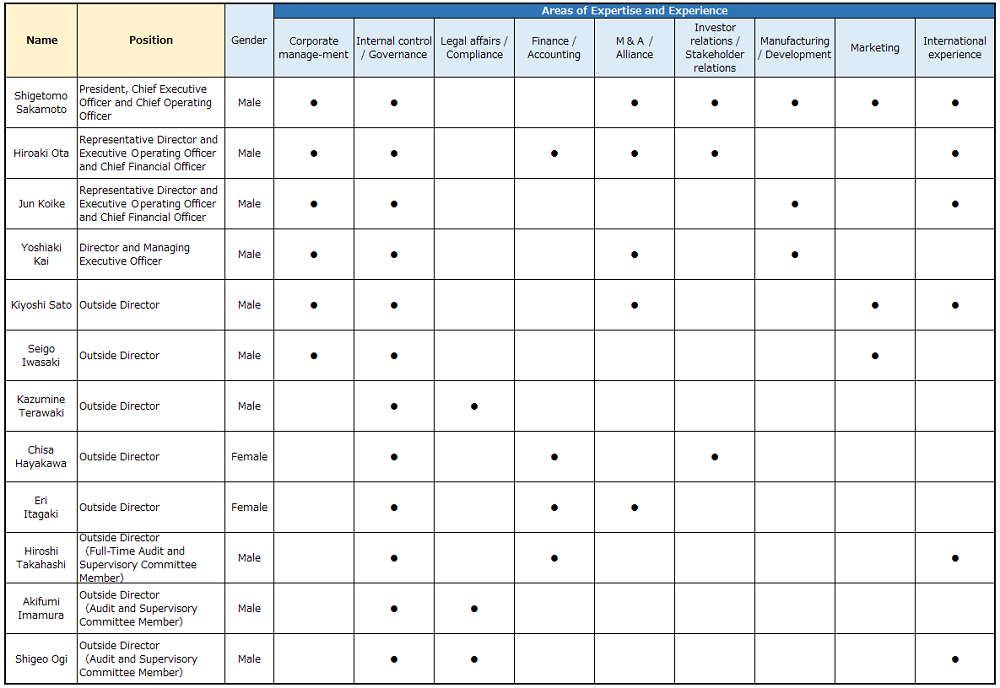
The above list does not necessarily represent all the expertise, experiences, and abilities held by the directors.
Policy on Training Directors
To enhance the knowledge and abilities of its directors and enable them to fulfill their roles and functions, the Company implements the following training programs. We organize external training specifically designed for newly appointed directors. We also organize external training for newly appointed presidents. Further, we provide outside directors with opportunities to deepen their understanding of the Company’s business, finances, and organization. In addition, training is provided for directors as needed.
Cross-Shareholdings
We believe that cooperative relationships with various companies are essential for the expansion and sustainable development of our business. From a medium- to long-term perspective to improve our corporate value, we have a policy of holding shares that are strategically necessary, taking into consideration their importance in terms of our business strategy and our business relationships with our business partners. Every year, the Board of Directors of our company reviews the appropriateness of individual cross-shareholdings, taking into consideration the purpose of holding them, the benefits, risks, capital costs, etc. of holding them. As a result of the review, we partially sold shares of one stock in fiscal 2025. In addition, we will review each proposal from the perspective of improving corporate value from a mediumto long-term perspective, our attitude toward shareholder returns, corporate governance, and social responsibility, and then exercise our voting rights.
Compensation of Directors
The stock compensation plan provides stock compensation to eligible directors— namely, directors other than outside directors or directors who are Audit and Supervisory Committee members—to increase the linkage between the compensation of eligible directors and the Company’s medium- to long-term corporate value. It also promotes a shared interest among eligible directors and shareholders, with the aim of providing an incentive to achieve the performance targets of the Company’s medium-term management plan and sustainably enhance corporate value. Accordingly, we have introduced the following basic policies in relation to the stock compensation plan.
- With a view to increasing corporate value over the medium to long term by transforming into a highly profitable company and sustaining growth, the Company shall provide fixed compensation, in the form of basic compensation, as well as variable compensation that establishes a sound incentive through the combination in appropriate proportions of (i) stock-based compensation subject to continuous service, (ii) cash bonuses linked to short-term performance, and (iii) stock compensation linked to medium- to long-term performance.
- A strong incentive to achieve performance targets shall be established by linking the Company’s medium-term management plan with stock compensation.
- To ensure that directors share with shareholders the benefits and risks of share price fluctuations, the proportion of stock compensation shall be increased, and directors shall be encouraged to hold more shares.
Outside directors:To ensure their independence, all outside directors receive basic compensation but do not receive performance- linked compensation.
Directors who are Audit and Supervisory Committee members: Such directors only receive basic compensation given their role, which primarily entails conducting legal compliance audits.
Effectiveness Evaluation of the Board of Directors
The Company conducts evaluations of the effectiveness of the Board of Directors with the aim of improving how it functions and, ultimately, enhancing corporate value.
In light of recommendations received from external organizations, we conducted an effectiveness evaluation in the manner shown in the box below.
| Results of Effectiveness Evaluation |
|---|
| We believe that the Board of Directors is effective on the whole. Generally positive evaluations were received with respect to the number of outside directors relative to inside directors, the frequency of meetings of the Board of Directors, free and open-minded, constructive discussions, and the understanding of agenda items in advance. |
In April 2026, a questionnaire was issued to all directors who comprised the Board of Directors at the time. The anonymity of the responses was ensured by having them sent directly to an external organization. Based on aggregated results reported by the external organization, analysis, discussion, and evaluation were conducted at a meeting of the Board of Directors held in May 2026.
A summary of the results of the aforementioned activities is stated below.
| Ongoing Tasks |
|---|
| We recognize the need to enhance discussions regarding ESG and sustainability. |
Internal control system
The SHIBAURA MACHINE Group has a "Basic Internal Control Policy" which defines operating systems for ensuring proper business conduct throughout the group. Underlying this policy is our belief it is an important duty of management to establish and operate systems for ensuring proper business execution pursuant to the group's Basic Commitment. The internal audit department and staff departments conduct independent internal audits to make sure internal control is working properly, and intensify and improve the internal control systems.
Group governance
The SHIBAURA MACHINE Group has developed proper group-wide internal control systems to raise the management efficiency and capabilities of the group. It also established the "SHIBAURA MACHINE Group Basic Governance Policy" to maximize the group's corporate value by promoting risk and compliance management. Both are part of its efforts to strengthen and improve its group governance.
Risk and compliance management
The SHIBAURA MACHINE Group uses the above basic commitments and the "SHIBAURA MACHINE Group Code of Conduct" as guiding principles in day-to-day business activities. Underlying these is its belief life, safety, and compliance with laws and regulations, social norms, and ethics, must come before everything when conducting business activities. We also have the "Risk and Compliance Management Rules" which establish, promote, and maintain a system for proactively controlling uncertainties (risks) involved in business activities and ensuring highly transparent business management (risk and compliance management system).
Finally, we also have a "whistle-blower system", which is accessible by employees and temporary employees of group companies, and a "supply chain reporting system" for business partners so we can collect sensitive risk information which might not be reported via regular channels.
Risk and compliance management system
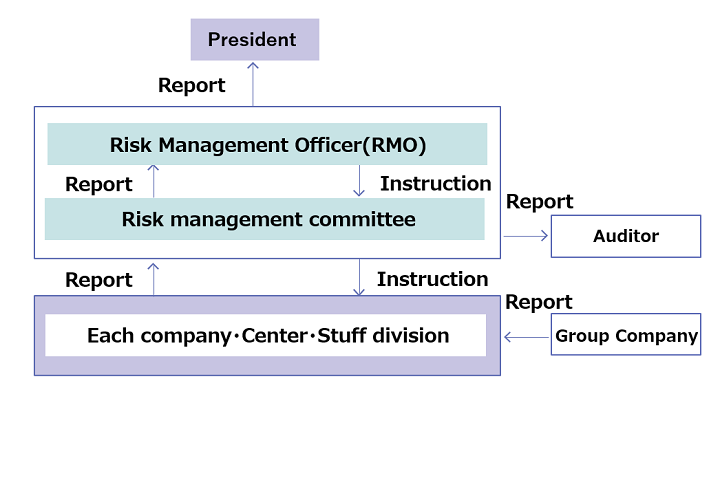
As specific elements of its risk and compliance management system, the SHIBAURA MACHINE Group appointed a risk management officer (RMO) who is in charge of risk and compliance management, and established a "risk management committee" which meets periodically.
Each business/staff division performs risk forecasting, prevention, self-inspection, and other forms of monitoring as part of its day-to-day management activities.
SHIBAURA MACHINE Group code of conduct
Concerning the business activities conducted based on the “SHIBAURA MACHINE Group Management Philosophy”, SHIBAURA MACHINE Group established the “SHIBAURA MACHINE Code of Conduct” by giving the highest priority to life, safety, and compliance (compliance with laws and regulations, social norms, and ethics) as the basis and, for its operation, each member demonstrates the specific actions to be complied with.